
Blog Details
Introduction
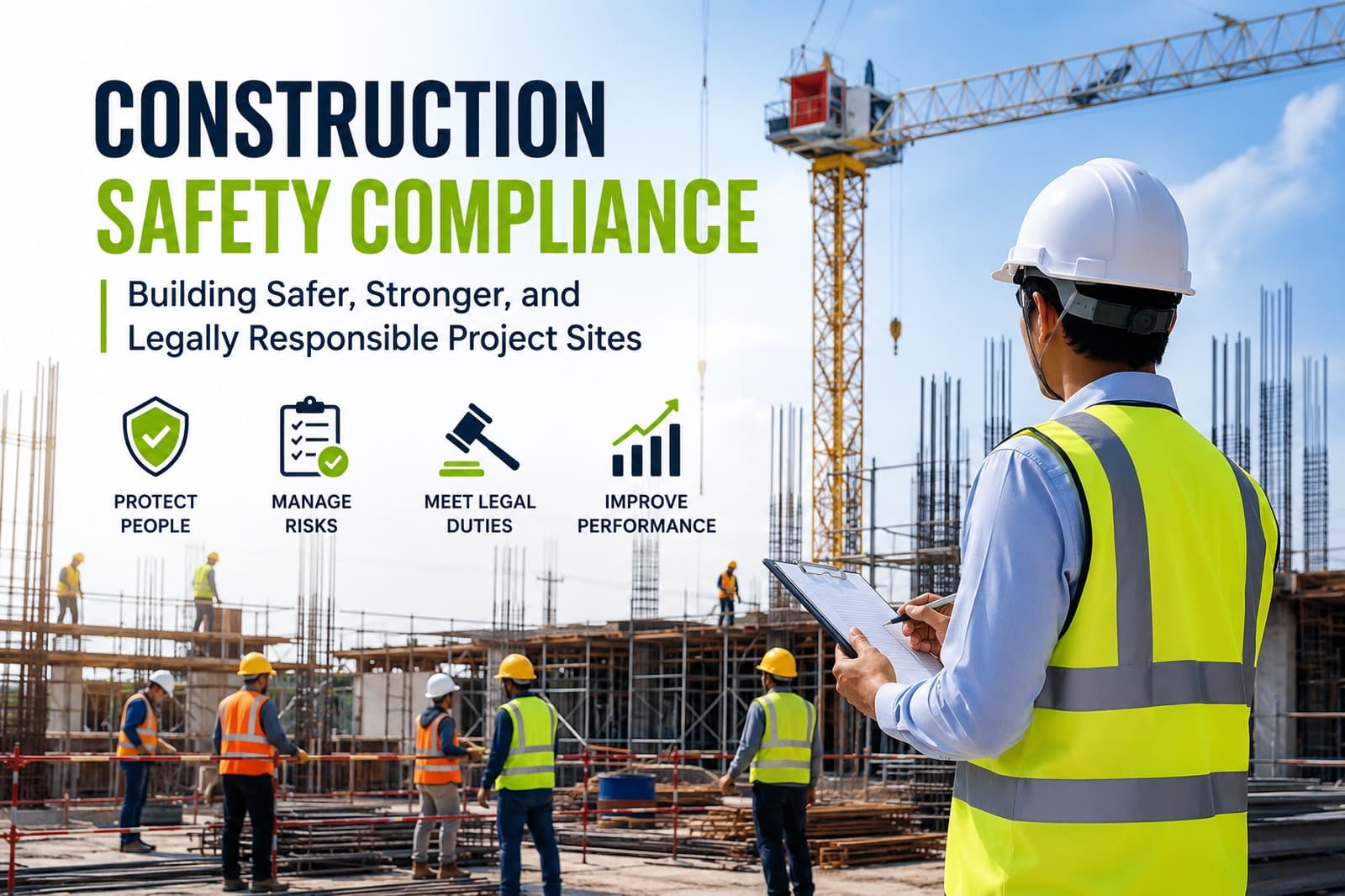
Construction is one of the most dynamic and high-risk industries in the world. Every project involves moving workers, temporary structures, plant and equipment, lifting activities, electrical works, work at height, excavations, traffic movement, subcontractors, changing site conditions, and tight project deadlines. Because of this, construction safety compliance is not just a legal requirement. It is a critical part of responsible project management.
A compliant construction site is not simply a site with documents in place. It is a site where legal duties are understood, hazards are actively controlled, workers are trained, contractors are managed, emergency arrangements are ready, and safety performance is reviewed throughout the full project lifecycle. HSE UK guidance highlights the need to plan, organise, control, monitor, and review health and safety throughout construction work.
For construction companies, developers, contractors, consultants, and project owners, compliance protects people, reduces liability, prevents costly delays, supports regulatory approval, and strengthens client confidence. More importantly, it helps ensure that every worker returns home safely at the end of the day.
What Construction Safety Compliance Really Means
Construction safety compliance means meeting all applicable legal, regulatory, contractual, and industry safety requirements for a construction project. This may include national occupational health and safety laws, construction regulations, approved codes of practice, client requirements, permit conditions, municipality requirements, civil defence requirements, environmental obligations, and international standards.
Depending on the country, the terminology may differ. Some jurisdictions refer to HSE, WHS, OSH, OHS, or QHSE. However, the goal remains the same: identify hazards, assess risks, implement effective controls, communicate responsibilities, monitor work activities, and keep evidence that the required controls are actually being followed.
Safe Work Australia’s construction code of practice explains that approved codes provide practical guidance on achieving the required health and safety standards, while also reminding duty holders that they must consider all risks associated with the work, not only those specifically covered by a code.
This is an important point for construction businesses. Compliance should never be treated as a checklist exercise only. A site may have forms, method statements, and inductions, but if workers are exposed to uncontrolled risks, the site is not truly compliant.
Why Construction Safety Compliance Matters
Construction safety compliance matters because construction work can change quickly. A safe activity in the morning can become unsafe in the afternoon due to weather, additional subcontractors, poor housekeeping, equipment movement, design changes, pressure to meet deadlines, or lack of supervision.
Strong compliance systems help construction teams:
OSHA’s Construction Focus Four training identifies falls, caught-in or between hazards, struck-by hazards, and electrocution as major construction hazard areas that require focused training and control. These hazards remain common across many construction environments, which is why compliance programs must give them specific attention.
Core Elements of Construction Safety Compliance
1.Legal and Regulatory Compliance Register
Every construction project should begin with a clear understanding of the applicable legal and other requirements. This includes national safety laws, construction regulations, fire and life safety requirements, environmental rules, labour requirements, local authority permits, client standards, and contractual HSE obligations.
A compliance register should identify:
This register should not remain in the office only. It should guide actual site practices, inspection checklists, contractor requirements, training plans, and audit criteria.
2. Construction Safety Management Plan
A construction safety management plan, construction phase plan, or project HSE plan is the main document that explains how safety will be managed on site. It should be specific to the project, not copied from another site.
A strong construction safety plan should include:
The plan should be reviewed whenever the project scope changes, new hazards are introduced, or serious incidents and near misses occur.
3. Hazard Identification and Risk Assessment
Risk assessment is the foundation of construction safety compliance. Before work starts, the project team must identify what can cause harm, who may be affected, how severe the consequence could be, and what controls are needed.
Safe Work Australia describes construction risk management as a systematic process that includes identifying hazards, managing risks, maintaining controls, and reviewing controls.
Common construction hazards include:
Risk assessments should be practical, communicated to the workforce, and reviewed at the workface. A risk assessment that workers have never seen or understood will not protect anyone.
4. Control of High-Risk Construction Activities
High-risk activities require stronger planning, supervision, and control. These activities should normally be supported by method statements, risk assessments, permits, competent supervision, and pre-start briefings.
Examples include:
5. Roles, Responsibilities, and Accountability
Construction safety compliance requires clear accountability. Clients, consultants, designers, main contractors, subcontractors, supervisors, safety officers, and workers all have roles to play.
Workers also have responsibilities. HSE UK guidance states that construction workers should be aware of site health and safety risks, follow site rules and procedures, cooperate with duty holders, and report risks they identify.
A compliant project should define:
Without clear responsibility, safety becomes everyone’s concern but no one’s accountability.
6. Competency, Induction, and Training
Workers must be competent for the tasks they perform. This means they should have the required knowledge, skill, training, experience, and supervision.
Construction training should include:
For fall hazards, OSHA requires training for employees who may be exposed to fall risks, including training to recognize fall hazards and understand procedures to minimize those hazards.
Training should not be treated as a one-time activity. Refresher training, toolbox talks, lessons learned, and supervisor coaching are essential to keeping safety requirements alive on site.
7. PPE and Fit-for-Purpose Protection
Personal protective equipment is not the first line of defence, but it remains an important part of construction safety compliance. PPE must be suitable for the task, properly fitted, maintained, and used correctly.
Common construction PPE includes:
OSHA notes that PPE hazards are addressed in specific construction standards and also highlights a 2025 revision requiring employers to provide properly fitting PPE for construction workers.
Poorly selected or badly fitting PPE can create additional risks. Compliance means ensuring PPE is practical, task-specific, and suitable for the worker.
8. Permit-to-Work and Safe Work Authorization
Permit-to-work systems are essential for controlling high-risk activities. A permit is not just a form. It is a formal authorization process confirming that hazards have been assessed, controls are in place, responsible persons are identified, and work can proceed safely.
Typical construction permits include:
A strong permit system should include proper approval, site verification, worker briefing, validity period, suspension conditions, and formal closeout.
9. Contractor and Subcontractor Safety Management
Construction projects often involve multiple subcontractors working at the same time. This creates interface risks, communication gaps, and inconsistent safety practices if not properly managed.
Contractor safety management should include:
Contractors should not be allowed to work on site simply because they are available. They must be competent, briefed, supervised, and aligned with the project’s safety requirements.
10. Emergency Preparedness and Response
Every construction site must be ready for emergencies. Emergency plans should reflect the real site conditions, including access limitations, number of workers, public interface, high-risk activities, weather exposure, and available emergency services.
Emergency arrangements should cover:
Emergency drills should be conducted, reviewed, and improved. A plan that has never been tested may fail when it is needed most.
11. Inspections, Audits, and Corrective Actions
Compliance must be verified. Regular inspections and audits help identify unsafe conditions, weak controls, documentation gaps, and recurring issues before they lead to serious incidents.
Construction sites should conduct:
Findings should be recorded, assigned to responsible persons, given deadlines, and closed with evidence. Repeated findings should be escalated and analysed for root causes.
12. Incident Reporting, Investigation, and Learning
A compliant safety system encourages reporting. Workers should feel safe to report hazards, near misses, unsafe acts, unsafe conditions, injuries, and property damage without fear of blame.
Incident investigations should identify:
The goal is not only to find out what happened. The goal is to prevent recurrence. Lessons learned should be shared across the project and, where relevant, across the wider organization.
13. Documentation and Evidence of Compliance
In construction safety, if it is not recorded, it may be difficult to prove. Documentation provides evidence that the organization has planned, implemented, monitored, and reviewed its safety arrangements.
Key construction safety records may include:
Good documentation should support safety, not replace it. The purpose is to prove that controls are understood, implemented, and verified.
Construction Safety Compliance Checklist
A construction site should regularly ask:
If the answer to any of these questions is unclear, the site may have a compliance gap that needs immediate attention.
The Role of Leadership in Construction Safety Compliance
Compliance cannot be delegated to the safety officer alone. Site leaders, project managers, construction managers, engineers, supervisors, and client representatives all influence safety outcomes.
Strong leadership means:
When leadership treats safety as a priority, compliance becomes part of the site culture. When leadership treats safety as paperwork, workers quickly notice.
About QHSE International
QHSE International is a global consultancy specializing in Quality, Health, Safety, Environment, ESG, Risk Management, Fire and Life Safety, Business Resilience, Emergency Preparedness and Response, and Business Continuity Planning.
With a presence across the UAE, Australia, United Kingdom, United States, Philippines, and Guinea, QHSE International supports organizations in developing practical, compliant, and internationally aligned management systems that protect people, improve performance, and strengthen operational resilience.
How QHSE International Can Support Construction Safety Compliance
QHSE International helps construction companies, contractors, developers, and project owners strengthen safety compliance through practical, site-focused QHSE solutions. Our approach is designed to help organizations move beyond paperwork and build construction safety systems that are properly implemented, monitored, and improved at site level.
Our support includes:
Whether your project is in building construction, infrastructure, industrial facilities, utilities, logistics, or oil and gas, QHSE International can help ensure that safety compliance is not only documented, but actively applied on site.
From construction safety compliance and site safety audits to emergency response planning, fire and life safety support, crisis management, and business continuity planning, we help organizations prevent incidents, strengthen compliance, and operate with confidence.
Conclusion
Construction safety compliance is not about passing inspections only. It is about creating a controlled, accountable, and safer work environment where legal duties are met, risks are managed, and workers are protected.
A compliant construction site is planned before work begins, monitored while work is underway, and improved through inspections, audits, reporting, and lessons learned. It is supported by leadership, understood by workers, and applied consistently by contractors and subcontractors.
In construction, every shortcut can carry serious consequences. Strong safety compliance helps organizations prevent incidents, protect lives, meet legal obligations, and deliver projects with confidence.
QHSE International helps organizations build safer, stronger, and more compliant construction sites through practical QHSE consultancy, training, auditing, and risk management support.