
Blog Details
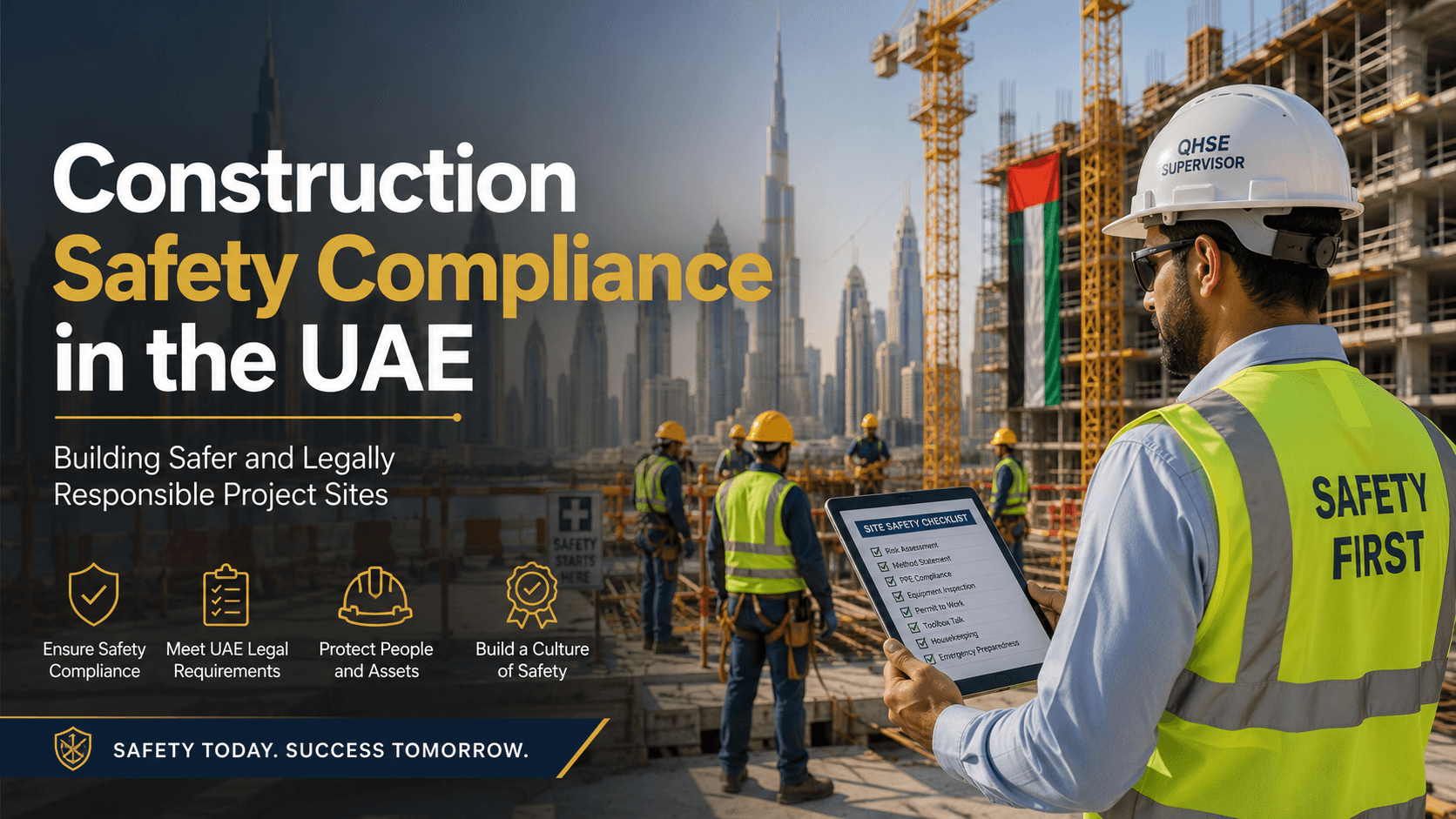
Construction is one of the UAE’s most active and fast-moving industries. Across Dubai, Abu Dhabi, Sharjah, and the wider UAE, construction projects continue to support the growth of commercial developments, residential communities, infrastructure, industrial facilities, utilities, logistics hubs, energy projects, and public-sector works.
With this growth comes significant responsibility. Construction sites involve work at height, lifting operations, scaffolding, excavation, mobile plant, electrical works, hot work, confined spaces, temporary works, subcontractors, public interface risks, and exposure to extreme weather conditions. Because of this, construction safety compliance in the UAE is not only a documentation requirement. It is a core part of protecting workers, meeting legal duties, preventing incidents, and delivering projects responsibly.
A compliant construction site is not simply a site with HSE forms and procedures. It is a site where legal requirements are understood, hazards are identified, risks are controlled, workers are trained, contractors are managed, emergency arrangements are tested, and safety performance is continuously monitored.
Construction safety compliance in the UAE means meeting applicable federal laws, emirate-level requirements, municipality regulations, Civil Defence requirements, client standards, and project-specific HSE obligations.
The UAE Government states that employers are required to provide a safe and appropriate work environment, and both employers and employees must comply with health and safety controls issued by MoHRE and other competent authorities. It also states that industrial establishments and construction-sector establishments with 100 workers or more must appoint a technically qualified Occupational Health and Safety Officer.
For construction businesses, compliance may include:
Compliance should never be treated as a checklist exercise only. A site may have HSE documents, inductions, and method statements, but if workers are exposed to uncontrolled risks, the project may still have serious compliance gaps.
Construction safety requirements in the UAE may vary depending on the emirate, project location, client, free zone, and approving authority. For example, Dubai has specific construction safety requirements through Dubai Municipality. Dubai’s Decree No. 19 of 2025 states that safety in construction works in the emirate is to be practiced according to the rules, standards, guidelines, and obligations set out in the Code of Construction Safety Practice in the Emirate of Dubai, prepared by Dubai Municipality in coordination with the competent entity.
Dubai Municipality also identifies the Dubai Building Code as a code intended to unify building design and mandate minimum requirements for health, safety, welfare, and convenience of people in and around buildings.
In Abu Dhabi, the Abu Dhabi Public Health Center provides the Abu Dhabi Occupational Safety and Health System Framework, and the Department of Municipalities and Transport notes that the building and construction sector regulatory authority supervises the establishment, development, and implementation of OSHMS by building and construction entities.
Because of these differences, construction companies in the UAE should always identify the exact legal, regulatory, free-zone, municipal, Civil Defence, and client requirements that apply to their project location.
Construction safety compliance matters because site conditions can change quickly. A safe activity in the morning can become unsafe later in the day due to weather, lifting operations, changes in access, multiple subcontractors, incomplete supervision, poor housekeeping, or pressure to meet deadlines.
Strong construction HSE compliance helps organizations:
In the UAE, safety performance is also closely linked to worker welfare, heat stress prevention, emergency preparedness, and public safety, especially on large and complex construction projects.
Every UAE construction project should begin with a clear legal and regulatory compliance review. This helps identify which requirements apply to the project and who is responsible for implementing them.
A compliance register should include:
This register should not remain as an office document only. It should guide site inspections, contractor requirements, risk assessments, method statements, permit-to-work controls, emergency planning, and audit criteria.
A project HSE plan is one of the most important documents for construction safety compliance. However, it must be site-specific. A generic plan copied from another project will not properly address the real hazards, site layout, subcontractor arrangements, work phases, emergency response needs, or authority requirements.
A strong UAE construction HSE plan should cover:
The HSE plan should be reviewed whenever the project changes, new risks are introduced, or significant incidents and near misses occur.
Risk assessment is the foundation of construction safety compliance. Before work begins, the project team must identify hazards, assess the risks, and define suitable controls.
Common construction hazards in the UAE include:
Risk assessments and method statements should be practical, communicated to the workforce, and verified by supervisors. A method statement that workers do not understand will not protect anyone.
High-risk construction activities require stronger planning, authorization, supervision, and monitoring. These activities should be supported by approved risk assessments, method statements, permits, competent personnel, and pre-task briefings.
Examples include:
Work at Height
Controls may include edge protection, safe access, scaffold inspection, fall arrest systems, ladder control, floor opening protection, and rescue arrangements.
Lifting Operations
Lifting work should be planned by competent personnel. Equipment must be inspected, loads must be secured, exclusion zones must be maintained, and communication must be clear between operators, riggers, signalers, and supervisors.
Excavation and Trenching
Excavation work requires ground assessment, utility identification, access and egress, edge protection, shoring or battering where required, and inspection before entry.
Hot Work
Hot work should be controlled through permits, fire watch, removal of combustibles, gas testing where required, fire extinguishers, and post-work monitoring.
Confined Space Entry
Confined space work requires atmospheric testing, ventilation, standby personnel, rescue planning, communication, and trained workers.
Traffic Management
Sites should separate vehicles, plant, workers, visitors, and the public as far as reasonably practicable. Traffic routes, barriers, walkways, signage, banksmen, and reversing controls are important.
Heat stress is a major construction safety concern in the UAE. Outdoor work, direct sunlight, high temperatures, humidity, and physically demanding tasks can increase the risk of heat-related illness.
The UAE’s midday break rule prohibits work under direct sunlight and in open places from 12:30 pm to 3:00 pm, from 15 June to 15 September every year. The UAE Government and MoHRE describe this as part of the occupational heat stress prevention policy.
Construction companies should ensure:
Heat stress management should be part of the project HSE plan, daily planning, toolbox talks, and site inspections.
Fire and life safety is a critical part of construction safety in the UAE. Construction sites often involve hot work, temporary electrical systems, combustible materials, fuel storage, temporary accommodation, and incomplete fire protection systems.
The UAE Fire and Life Safety Code of Practice is used as a standard reference to help ensure Civil Defence safety requirements are properly implemented by contracting companies, consultants, and other concerned parties.
Fire and life safety controls should include:
Fire safety should be actively managed from the start of construction, not only near project handover.
Construction projects in the UAE often involve multiple subcontractors working at the same time. This creates interface risks, inconsistent standards, communication gaps, and supervision challenges.
Contractor safety management should include:
Subcontractors should not be allowed to work simply because they are available. They must be competent, briefed, supervised, and aligned with the project’s HSE requirements.
Compliance must be verified. Regular inspections and audits help identify unsafe conditions, weak controls, documentation gaps, and recurring issues.
A construction site should conduct:
Findings should be recorded, assigned to responsible persons, given deadlines, and closed with evidence. Repeated findings should be escalated and reviewed for root causes.
Construction companies should regularly ask:
If the answer to any of these questions is unclear, the site may have a compliance gap that needs immediate attention.
QHSE International is a global consultancy specializing in Quality, Health, Safety, Environment, ESG, Risk Management, Fire and Life Safety, Business Resilience, Emergency Preparedness and Response, and Business Continuity Planning.
With a presence across the UAE, Australia, United Kingdom, United States, Philippines, and Guinea, QHSE International supports organizations in developing practical, compliant, and internationally aligned management systems that protect people, improve performance, and strengthen operational resilience.
QHSE International UAE helps construction companies, contractors, developers, consultants, and project owners strengthen safety compliance through practical, site-focused HSE and QHSE solutions.
Our support includes:
Whether your project is in building construction, infrastructure, industrial facilities, utilities, logistics, energy, oil and gas, or public-sector works, QHSE International UAE can help ensure that construction safety compliance is not only documented, but actively applied on site.
From construction HSE audits and site safety inspections to risk assessment review, contractor safety management, emergency response planning, fire and life safety support, and ISO 45001 consultancy, we help organizations prevent incidents, strengthen compliance, and operate with confidence.
Construction safety compliance in the UAE requires more than forms, procedures, and approvals. It requires clear responsibilities, competent people, practical HSE systems, effective contractor coordination, strong supervision, regular inspections, and continuous improvement.
A compliant construction site is one where workers understand the risks, supervisors verify controls, contractors are held accountable, and safety requirements are updated as the project changes.
In a fast-moving construction environment, every shortcut can carry serious consequences. Strong HSE compliance helps organizations protect workers, meet legal obligations, reduce project disruption, and build trust with clients, regulators, consultants, and the wider community.
QHSE International UAE helps organizations build safer, stronger, and more compliant construction sites through practical HSE consultancy, auditing, training, ISO 45001 support, and construction safety management solutions.