
Blog Details
Industry: Industrial / High-Risk Workplace
Location: Australia
Service: Emergency Preparedness & Response Review
Focus: WHS emergency planning, worker readiness, drills, communication and continuous improvement
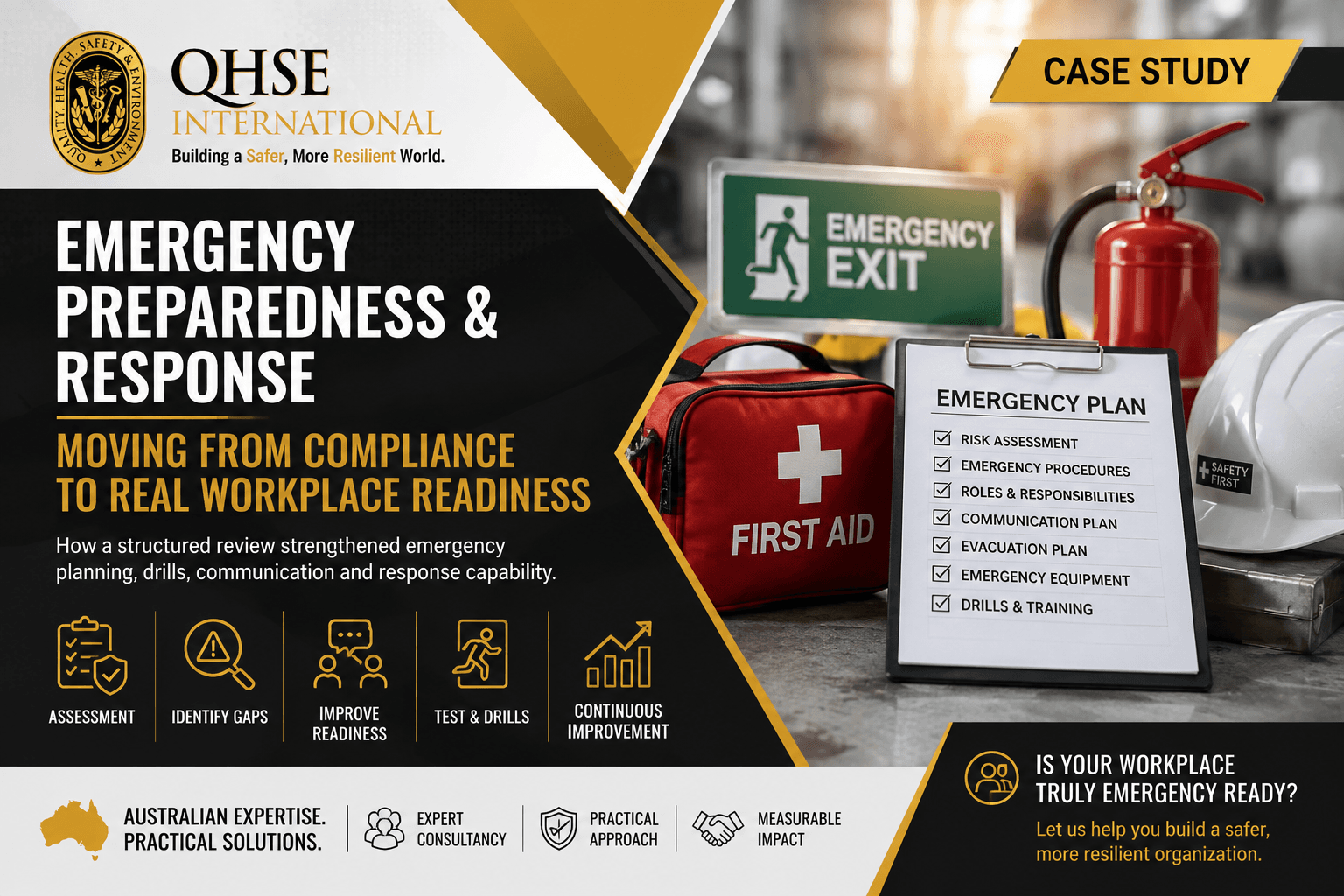
Illustrative Case Study: This scenario demonstrates the type of emergency preparedness review QHSE International can undertake. Client-specific details and measurable results should only be added where supported by an actual engagement.
The workplace had the fundamentals of emergency preparedness in place.
There was an emergency response plan. Evacuation arrangements had been established. Emergency personnel had been nominated and periodic drills were conducted.
The question from management, however, went beyond documentation:
Would the system actually work during a real emergency?
The organization wanted greater confidence that workers understood their responsibilities, emergency communications would function effectively, drills were genuinely testing readiness and identified weaknesses were being followed through to closure.
QHSE International's review therefore focused not simply on whether procedures existed—but on whether the workplace was operationally ready to respond.
The assessment examined both documented arrangements and their practical implementation.
Key areas reviewed included:
The review was designed to identify the gap between what the emergency plan said should happen and what was realistically likely to happen under pressure.
Emergency personnel had been nominated, but some responsibilities and escalation arrangements required clearer definition.
During an emergency, uncertainty about who has authority to act can result in delays, duplication or conflicting instructions.
Improvement priority: Clearly define emergency roles, alternates, decision-making authority and escalation pathways.
Employees generally understood evacuation requirements, but awareness of broader emergency responsibilities varied.
Some workers knew where to assemble but were less familiar with communication protocols, emergency reporting or actions for specific scenarios.
Key lesson: A workplace can have a compliant emergency plan without having a workforce that is genuinely emergency ready.
Emergency drills were occurring, but they primarily demonstrated whether people could evacuate.
Greater value could be achieved by testing:
Improvement priority: Move from routine drills toward structured, scenario-based exercises.
Opportunities for improvement had been identified through previous exercises, but the process for assigning responsibility, establishing deadlines and verifying closure could be strengthened.
Key lesson: A drill only improves preparedness when lessons identified lead to action.
Contractors and temporary personnel may not have the same familiarity with the workplace as permanent employees.
Emergency arrangements therefore needed to more clearly address how contractors receive emergency information, understand alarms and participate in evacuation and accountability processes.
QHSE International's proposed improvement priorities included:
The review changed the organization's focus from:
“Do we have an emergency plan?”
to:
“Can our people actually implement it when it matters?”
Management gained a clearer picture of existing strengths, practical vulnerabilities and priority improvement areas.
More importantly, emergency preparedness was repositioned from being primarily a documentation and compliance activity to becoming an operational capability requiring training, testing, leadership and continuous improvement.
This case study highlights five important principles:
The real measure of emergency preparedness is not how good the plan looks.
It is what happens when the alarm sounds.
QHSE International supports Australian organizations in strengthening practical workplace emergency preparedness through:
Don't wait for a real emergency to expose weaknesses in your arrangements.
Talk to QHSE International Australia about assessing, testing and strengthening your workplace emergency preparedness and response capability.