Blog Details
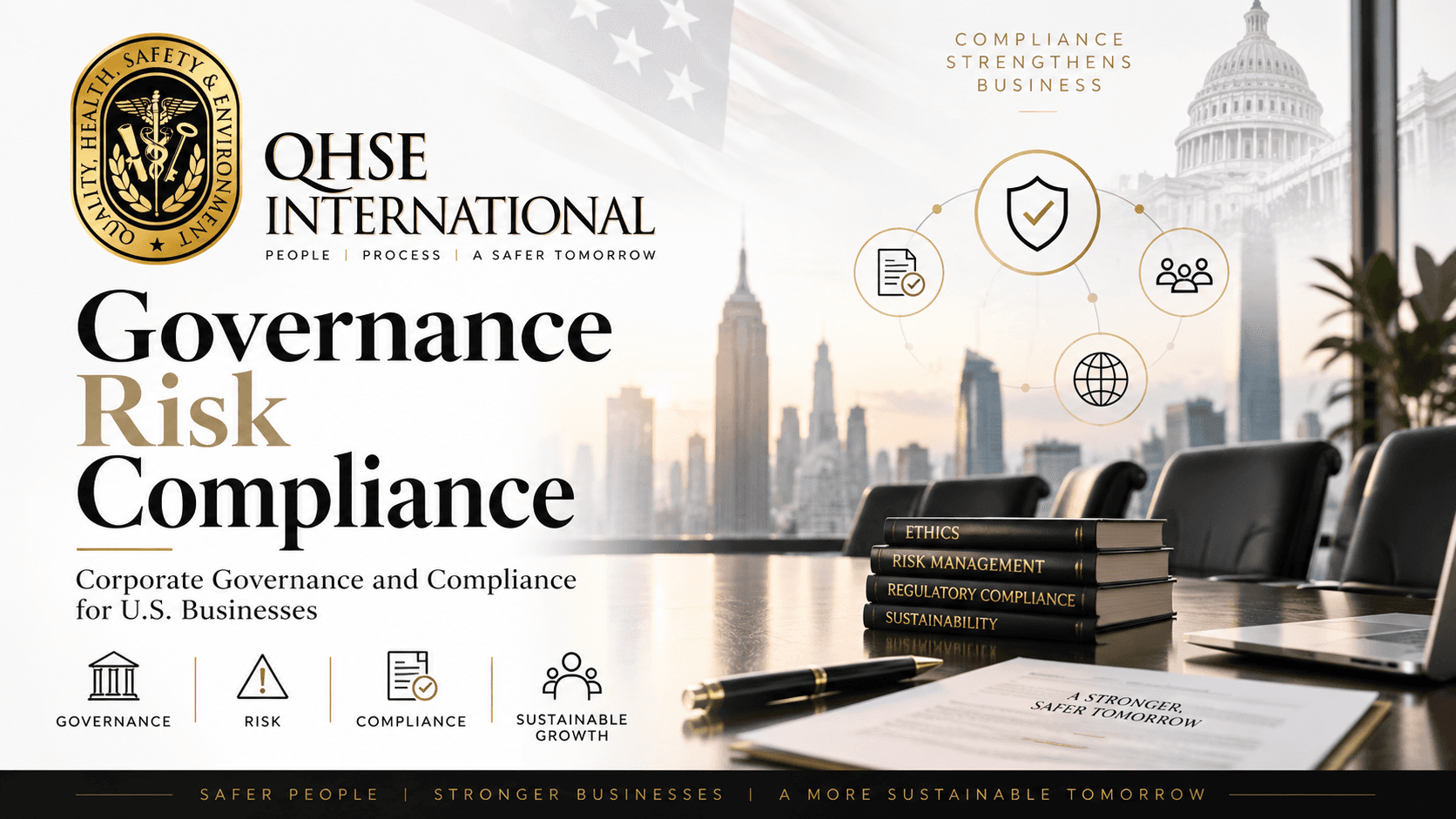
Governance Risk Compliance is becoming increasingly important for organizations operating in the United States. Businesses today are expected to do more than simply meet minimum legal requirements. Customers, investors, employees, regulators, insurers and business partners increasingly expect organizations to demonstrate strong corporate governance, effective risk management and reliable compliance systems.
Good governance provides direction and accountability. Risk management helps organizations identify threats before they become serious problems. Compliance helps ensure operations meet applicable laws, regulations, contractual requirements and internal policies.
When these areas operate together rather than independently, organizations can make better decisions, protect their reputation and create more sustainable operations.
At QHSE International USA, our approach is based on practical, risk-based management systems that help organizations strengthen compliance while improving overall business performance.
Effective Governance Risk Compliance begins with understanding that governance is not simply the responsibility of a board of directors or senior executives.
Governance affects how decisions are made throughout an organization. It determines who has authority, who is accountable, how risks are escalated and how performance is monitored.
Compliance is equally broad. Depending on the organization, compliance obligations may include occupational safety requirements, environmental regulations, employment laws, cybersecurity requirements, financial controls, contractual obligations, industry standards, licensing requirements and corporate reporting.
A fragmented system can create gaps. One department may manage safety, another manages environmental requirements, another handles quality, while finance, HR, IT and legal departments manage their own risks separately.
A stronger approach connects these functions through a coordinated Risk Management framework.
This allows leadership to see the organization as a whole rather than dealing with risks one department at a time.
Corporate governance should establish clear expectations for how an organization operates and makes decisions.
Leadership must first define responsibility. Employees need to understand who is responsible for approving policies, reviewing risks, investigating concerns, monitoring compliance and implementing corrective actions.
The second foundation is transparency. Important information should move upward through the organization quickly enough for leadership to make informed decisions.
The third foundation is accountability. Policies have little value if responsibilities are unclear or corrective actions remain open indefinitely.
Strong governance therefore requires more than written procedures. Organizations need systems for monitoring whether those procedures are actually being followed.
Internal audits, management reviews, performance indicators, inspections and risk assessments all provide management with evidence about whether the system is working.
This is where professional QHSE consultancy and compliance services can support organizations that need an independent assessment of their existing systems.
Compliance should not become an annual exercise completed shortly before an external audit or regulatory inspection.
Organizations with mature Management Systems incorporate compliance into normal operations.
For example, regulatory obligations can be incorporated into procedures, training programs, risk assessments, purchasing controls, contractor management systems and inspection schedules.
A practical corporate compliance framework should normally address:
The goal is not to create unnecessary paperwork. The goal is to establish enough structure that management can demonstrate what requirements apply, who is responsible for them and whether they are being effectively controlled.
One of the biggest mistakes organizations make is treating every compliance issue as equally important.
Risk-based compliance prioritizes resources according to the likelihood and potential consequences of failure.
A construction company may have significant risks involving fall protection, subcontractor management and OSHA compliance. A healthcare organization may prioritize patient safety, privacy and emergency preparedness. A manufacturing facility may concentrate on hazardous energy, environmental controls, equipment safety and supply-chain risk.
Senior management should periodically review the organization's risk profile and ask whether existing controls remain appropriate.
This becomes especially important when the company expands, introduces new technology, enters new markets, acquires another company or begins working with new suppliers.
An effective Risk Management system therefore changes as the organization changes.
The U.S. regulatory environment continues to emphasize whether corporate compliance programs actually work in practice rather than simply whether policies exist.
In March 2026, the U.S. Department of Justice introduced its first Department-wide Corporate Enforcement and Voluntary Self-Disclosure Policy for corporate criminal matters. The policy emphasizes incentives for companies that voluntarily identify misconduct, cooperate with investigations and appropriately remediate problems.
That is an important governance message for organizations of all sizes.
Management needs systems capable of identifying problems early, escalating them appropriately, investigating concerns and documenting corrective action.
The DOJ's corporate compliance guidance also evaluates issues such as risk assessment, management commitment, the independence and resources of compliance personnel, training, reporting mechanisms and whether compliance programs are periodically tested and improved.
In other words, having a policy manual sitting on a shelf is not the same as having an effective compliance program.
Artificial intelligence is quickly becoming a corporate governance issue rather than simply an IT issue.
Organizations are using AI for hiring, document preparation, analytics, customer service, pricing, procurement, risk assessment and operational decision-making.
Leadership therefore needs to understand where AI is being used, what data it accesses, who reviews its output and what controls exist to prevent misuse.
This is already reflected in U.S. compliance guidance. The Department of Justice's Evaluation of Corporate Compliance Programs specifically asks companies how they assess risks associated with technologies such as artificial intelligence and whether AI-related risk is integrated into broader enterprise risk management.
For companies developing governance programs in 2026, AI governance should increasingly be considered alongside cybersecurity, information security, privacy and traditional operational risk.
Cybersecurity provides another clear example of how corporate governance is changing.
For U.S. public companies subject to SEC reporting requirements, cybersecurity governance is no longer simply a technical matter delegated entirely to IT.
SEC rules require covered registrants to disclose information concerning processes used to assess and manage material cybersecurity risks, management's role in those risks and the board's oversight of cybersecurity risk. Material cybersecurity incidents may also trigger Form 8-K disclosure requirements.
Even organizations that are not publicly traded can learn something from this approach.
Cyber risk affects business continuity, operational resilience, customer confidence, financial performance and reputation. It therefore belongs within the organization's wider governance and risk structure.
For organizations operating in Florida, corporate governance also includes maintaining basic corporate filings and ensuring official company records remain accurate.
Florida businesses required to file annual reports had until May 1, 2026 to file before a $400 late fee applied. Florida's Division of Corporations states that entities failing to file an annual report by the third Friday in September can ultimately face administrative dissolution or revocation.
While an annual report may appear to be a simple administrative requirement, it demonstrates an important point about governance: compliance obligations exist at multiple levels.
A company may simultaneously have federal, state, local, contractual, industry and management-system requirements.
A good compliance register should identify those obligations and assign responsibility for monitoring deadlines.
Governance is also a central component of ESG Consulting and sustainability programs.
Organizations sometimes focus heavily on the environmental and social components of ESG while overlooking governance.
However, environmental commitments and social policies depend on governance structures to make them credible.
Leadership oversight, ethical conduct, anti-bribery controls, supplier management, reporting processes, risk management and internal assurance all contribute to governance.
The same systems can also support Operational Excellence.
For example, an internal audit may identify a compliance problem but also uncover duplicated processes, unnecessary approvals or inefficient documentation. A risk assessment may reveal not only a safety hazard but also a potential production interruption.
Good governance therefore supports more than regulatory compliance. It can improve decision-making and organizational efficiency.
Organizations should periodically test their governance and compliance systems rather than assuming they are functioning correctly.
Internal audits provide an opportunity to independently review whether policies are being followed, records are maintained, responsibilities are understood and corrective actions are completed.
Audits can also identify weaknesses before they result in regulatory action, client complaints, incidents or operational disruption.
An audit should not simply ask, "Do we have a procedure?"
It should also ask, "Is the procedure being implemented, is it effective and can we demonstrate that it works?"
That same philosophy is used throughout ISO management systems and effective corporate compliance programs.
Organizations interested in developing this broader approach can also review QHSE International's article on proactive safety management and construction compliance, which demonstrates how structured systems can move organizations beyond checklist-based compliance.
Employees cannot comply with requirements they do not understand.
Training should therefore be linked directly to organizational risks, employee responsibilities and applicable procedures.
Senior management may require governance and risk awareness. Supervisors may need additional training on incident escalation, investigations or employee responsibilities. Operational personnel may require task-specific safety, environmental or quality training.
The organization's training matrix should define required competencies and identify when refresher training is necessary.
QHSE International also provides training services that can support organizations building competency alongside their broader management and compliance systems.
Consider a growing U.S. manufacturing company operating several facilities.
Initially, safety, quality, HR, environmental compliance and cybersecurity may all be managed independently.
As the company expands, management begins seeing recurring problems: overdue corrective actions, inconsistent contractor requirements, duplicated audits and different departments maintaining separate risk registers.
Rather than adding more individual procedures, the organization develops an integrated governance structure.
Responsibilities are clarified. Major risks are consolidated into an enterprise-level risk register. Compliance obligations are assigned to responsible managers. Internal audits evaluate multiple areas together. Significant findings are reported to senior management, and corrective actions are tracked centrally.
The result is not simply better compliance.
Management gains clearer visibility of business risks and can make better-informed decisions.
That is the real purpose of Governance Risk Compliance.
Effective Governance Risk Compliance is not about creating more paperwork or adding another layer of administration.
It is about creating an organization where responsibilities are clear, risks are understood, compliance obligations are controlled and leadership receives reliable information for decision-making.
Strong corporate governance supported by Compliance Consulting, Risk Management, effective Management Systems, appropriate ESG Consulting, and a focus on Operational Excellence can help businesses reduce risk while improving resilience and performance.
For organizations that are unsure whether their governance and compliance systems are effective, an independent review, gap assessment or internal audit can provide a practical starting point.
QHSE International USA can support organizations with compliance reviews, risk assessments, internal audits, management systems, regulatory support and governance-related consultancy tailored to their operations.