
Blog Details
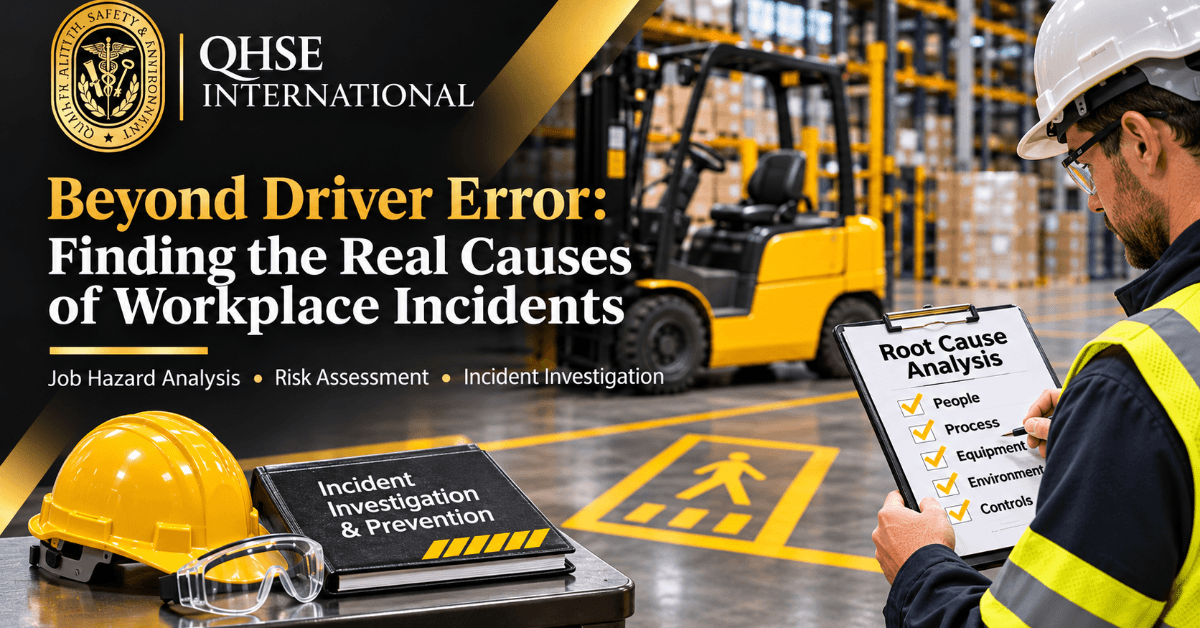
When a workplace vehicle incident occurs, is driver error really the cause—or just the easiest explanation?
A forklift strikes a warehouse rack. A delivery truck reverses into equipment. A company vehicle nearly hits a pedestrian.
The investigation concludes: Driver failed to pay attention.
The employee receives additional training, a warning is issued, and operations resume.
But what if the same incident happens again?
For organizations focused on Workplace Safety USA, identifying driver error is only the beginning of an effective investigation. Preventing future incidents requires understanding the workplace conditions, operational decisions, and management system weaknesses that contributed to the event.
Through Job Hazard Analysis, Risk Assessment, and Incident Investigation, organizations can move beyond individual mistakes to identify and control the underlying hazards.
Human error can contribute to workplace incidents, but it rarely explains every factor involved.
Consider a forklift operator who collides with a storage rack while reversing. The initial investigation identifies improper observation as the cause.
A closer examination, however, might reveal:
Limited visibility caused by the warehouse layout.
Pedestrian and vehicle routes without clear separation.
Excessive workloads or unrealistic production deadlines.
Inadequate lighting or damaged floor markings.
Outdated operating procedures.
Insufficient supervision or equipment maintenance.
Repeated near misses that were never investigated.
Each condition represents a potential weakness in workplace risk controls.
Simply reminding the operator to pay attention may address one behavior without reducing the underlying exposure.
A stronger investigation asks not only what the driver did, but why the workplace allowed that action to result in an incident.
That distinction is essential for organizations seeking sustainable improvements in occupational safety.
A Job Hazard Analysis (JHA) helps organizations systematically identify the hazards associated with individual work activities.
Rather than evaluating a job as one general operation, a JHA breaks the work into specific steps, examines potential hazards, and identifies appropriate controls.
For vehicle-related activities, an effective JHA might examine:
1. Pre-operational inspections
Are employees checking brakes, tires, warning devices, and other safety-critical equipment before use?
2. Vehicle movement
Are travel routes clearly established? Do operators have sufficient visibility, and are speed limits appropriate for workplace conditions?
3. Loading and unloading
Are loads secured, equipment capacities respected, and employees protected from moving vehicles or unstable materials?
4. Pedestrian interaction
Are designated walkways, physical barriers, crossings, and traffic management procedures adequate?
5. Reversing and maneuvering
Have blind spots, obstructions, reversing distances, and available warning systems been evaluated?
The purpose is not simply to complete a JHA form. It is to ensure that identified hazards lead to practical risk controls.
For U.S. workplaces, an effective JHA should consider applicable OSHA requirements and the actual conditions employees encounter during their work.
Organizations can strengthen this process through independent EHS consulting and workplace safety assessments that evaluate both regulatory requirements and operational risks.
While a JHA examines specific job steps, a broader Risk Assessment evaluates potential incidents, their consequences, and the effectiveness of existing controls.
A useful assessment considers three questions:
What could happen?
A forklift could strike a pedestrian, a delivery vehicle could overturn, or a worker could become trapped between equipment and a fixed structure.
How serious could the outcome be?
Potential consequences range from equipment damage to serious injury or fatality.
How effectively is the hazard controlled?
Existing measures must be evaluated against actual workplace conditions, not simply whether a policy exists.
For example, a warehouse may have a written traffic management procedure. However, if pedestrian walkways intersect with high-volume forklift routes without adequate separation, the exposure remains.
Risk assessments should therefore examine how work is performed, including nonroutine tasks, maintenance activities, temporary changes, and peak production periods.
Where appropriate, organizations should prioritize engineering controls and safer work arrangements over reliance on reminders, warnings, or retraining alone.
This approach supports effective Risk Management and helps companies direct resources toward hazards with the most significant potential consequences.
An effective Incident Investigation should establish the sequence of events and identify the factors that contributed to the outcome.
A finding of driver inattention should prompt further questions:
Why was the hazard difficult to recognize?
Were suitable operating procedures available and understood?
Were employees under pressure to complete tasks quickly?
Had similar incidents or near misses occurred previously?
Were hazards identified during earlier safety audits?
Did supervisors know about the unsafe conditions?
What prevented existing safety controls from working?
These questions shift the focus from individual blame toward organizational learning.
This does not mean employees have no responsibility for following safe work practices. It means corrective action should address both individual conduct, where relevant, and the conditions that made the incident possible.
For example, if a driver failed to observe a pedestrian entering a vehicle route, an investigation might identify inadequate pedestrian segregation, poor sightlines, ineffective signage, and insufficient traffic management.
Corrective actions could then include redesigning pedestrian access, installing protective barriers, improving intersection visibility, and updating work procedures.
These improvements are more likely to reduce future exposure than retraining alone.
Organizations seeking to strengthen their processes can explore QHSE International's Incident Investigation, Risk Management, and technical consultancy services.
Consider a hypothetical distribution facility where a forklift narrowly misses a warehouse employee at an intersection.
The operator reports being distracted by another vehicle approaching from the opposite direction.
An initial investigation might record the incident as operator inattention.
A more thorough review identifies additional concerns:
The intersection has obstructed sightlines because of stored materials. Pedestrian traffic crosses the same route used by forklifts. Floor markings have deteriorated, and there is no effective physical separation.
Employees also report that similar near misses have occurred during busy delivery periods.
The findings suggest that the problem is not limited to one operator.
The facility's traffic management system has failed to adequately control predictable interactions between vehicles and pedestrians.
A revised risk assessment identifies several corrective actions, including relocating stored materials, improving visibility, establishing separated pedestrian routes, and reviewing vehicle traffic patterns.
Supervisors then verify that the new controls are functioning and employees understand the revised procedures.
This example highlights an important principle:
The goal of an investigation is not merely to explain the previous incident. It is to prevent the next one.
Safety Audits provide an opportunity to identify weaknesses before they contribute to an incident.
However, audits become less effective when they focus exclusively on documents and completed checklists.
A procedure may be formally approved without reflecting how employees perform their work. Training records may be current even though workplace conditions have changed.
A practical audit should consider whether:
Job Hazard Analyses reflect current tasks and equipment.
Risk assessments are reviewed after operational changes or incidents.
Employees understand workplace hazards and required controls.
Reported near misses result in corrective action.
Vehicle routes and pedestrian access remain adequately controlled.
Supervisors verify that corrective actions are effective.
Where applicable, audits should also consider associated risks such as Hazard Communication for hazardous materials and Fall Protection during elevated vehicle access, loading, or maintenance work.
These activities may involve different regulatory requirements, but they share the same underlying principle: hazards must be identified, evaluated, and controlled.
An effective audit does not stop at identifying nonconformities. It examines whether the organization's safety management processes are capable of preventing recurrence.
One of the greatest barriers to identifying underlying incident causes is a workplace culture in which employees fear being blamed for reporting mistakes or near misses.
When workers believe that reporting an unsafe condition will automatically result in disciplinary action, important information may remain hidden.
Effective Safety Leadership creates an environment where employees can raise concerns and management responds appropriately.
This requires more than encouraging people to speak up.
Organizations must demonstrate that reports lead to meaningful improvements, communicate investigation findings, and involve employees in evaluating corrective actions.
Supervisors should also be equipped to recognize changing workplace conditions, question ineffective procedures, and escalate unresolved risks.
A positive reporting culture does not eliminate accountability. It enables organizations to distinguish deliberate unsafe conduct from human error, inadequate systems, and conditions beyond an employee's immediate control.
By focusing on learning and prevention, businesses can strengthen operational reliability while improving workforce participation.
A completed incident report is not proof that a risk has been controlled.
Corrective actions must be implemented, assigned to responsible individuals, and evaluated for effectiveness.
Organizations should establish a process that includes documenting underlying causes, identifying appropriate controls, setting completion deadlines, and confirming implementation.
For higher-risk vehicle activities, this may involve reviewing traffic layouts, maintenance practices, operating procedures, supervision, and competency requirements.
Management should also examine whether similar exposures exist in other departments or locations.
An incident involving one forklift, for example, may reveal traffic management weaknesses affecting an entire distribution network.
Using investigation findings to update Job Hazard Analyses, Risk Assessments, and internal audit programs helps connect reactive learning with proactive prevention.
This continual improvement approach is also consistent with the principles of ISO 45001 occupational health and safety management systems, which emphasize identifying hazards, managing risks, involving workers, and improving safety performance.
For organizations managing multiple facilities, consistent evaluation methods can help identify recurring risks while allowing controls to reflect local operating conditions.
Organizations operating in the United States must consider applicable OSHA regulations alongside the actual hazards created by their activities.
For example, workplaces using powered industrial trucks must address applicable requirements under 29 CFR 1910.178, including operator training and safe operation.
However, regulatory compliance should be viewed as a foundation rather than the limit of risk management.
A technically compliant procedure does not automatically guarantee effective hazard control.
Strong safety performance depends on connecting documented requirements with workplace observations, employee feedback, management commitment, and ongoing verification.
Integrating JHA, Risk Assessment, Incident Investigation, and Safety Audits provides a more complete picture of organizational risk.
This approach also supports business continuity by helping reduce avoidable operational interruptions, equipment damage, and workplace injuries.
For employers seeking practical Compliance Consulting, the priority should be developing systems that work under real operating conditions—not merely producing additional paperwork.
When an investigation concludes that a driver made a mistake, the most important work may still be ahead.
Was the hazard foreseeable? Were effective controls in place? Did previous warning signs go unnoticed? Could the same event happen tomorrow under similar conditions?
These questions determine whether an investigation produces meaningful prevention or simply closes another report.
Driver error may explain what happened. Understanding why it happened is what helps prevent recurrence.
Through effective Job Hazard Analysis, Risk Assessment, root cause investigation, and stronger safety leadership, organizations can turn workplace incidents into opportunities for lasting improvement.
QHSE International USA supports organizations with workplace safety assessments, incident investigation, risk management, internal audits, OSHA-aligned compliance support, and management system improvement.
Whether your organization is reviewing a recent incident or looking to strengthen proactive hazard identification, our team can help identify practical opportunities to improve workplace safety and operational performance.
Explore our QHSE International USA services or learn more about our consultancy and risk assurance solutions.